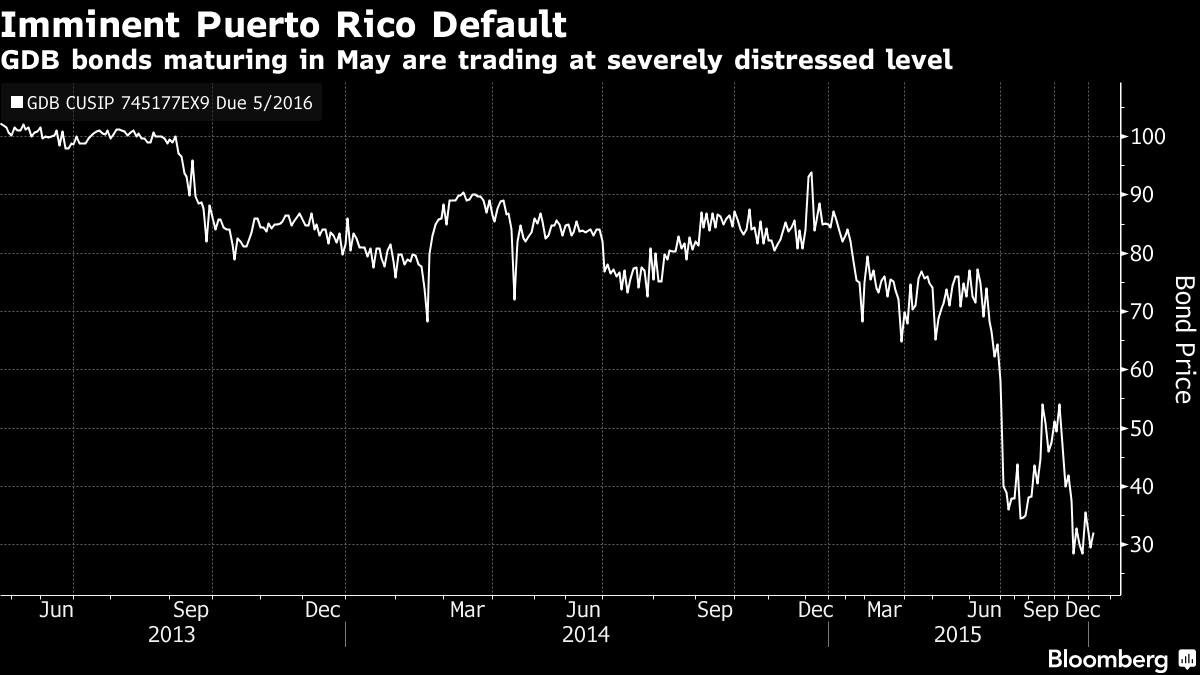
Make no mistake about it: Puerto Rico will default in May on some of the $470 million it owes, according to Moody’s Investors Service.
The cash-strapped commonwealth is expected to fall short of paying $422 million to holders of bonds from the Government Development Bank, the credit rater said Friday in a report. It may also default on debt from the Employees Retirement System, Industrial Development Co. and Highways and Transportation Authority because the GDB has just $562 million in liquidity as of April 1, Moody’s said.
“These impending defaults would follow the government’s efforts to emphasize its severe cash depletion during the past year,” Moody’s analysts led by Ted Hampton and Emily Raimes wrote. “Even if federal oversight legislation is passed by the end of next week, Puerto Rico will still default because the commonwealth treasury and the GDB, which has long been the government’s fiscal agent, have insufficient liquidity for upcoming debt payments.”
Moody’s expects Puerto Rico to pay the less than $3 million owed to holders of general-obligation bonds and securities guaranteed by the commonwealth’s constitution to “avoid the almost certain litigation that would quickly follow.” Sales-tax backed debt, known by the Spanish acronym Cofina, will pay with funds already deposited with the trustee.
Appropriation debt from the Public Finance Corp., which accounts for 75 percent of all Puerto Rico defaults so far, will fail to pay yet again, Moody’s said.
Treasury Secretary Jack Lew recently visited Puerto Rico in an effort to show the administration’s support for the beleaguered territory. Lew’s comments on his trip to San Juan and his January 15 letter to House Speaker Paul Ryan (R-Wis.) make it clear that when it comes to Puerto Rico, the administration largely equates “support” with “bankruptcy.” The administration’s well-intentioned desire to help the people of Puerto Rico is laudable, but it is a mistake to give Puerto Rico the power to rewrite its laws and contracts through a retroactive application of new bankruptcy laws. The administration’s position is neither good policy for Puerto Rico nor the United States. Ambac is one of the country’s largest guarantors of municipal and state debt. In Puerto Rico, we insure well over $2 billion of the Commonwealth’s various debt obligations, and our commitments to the island extend until the year 2054. Our financial support of the Commonwealth helped build i...
This week, Puerto Rico faces another critical juncture in its debt crisis, as the House will devote simultaneous hearings to the island’s fiscal situation on Thursday. I will appear alongside a panel of other witnesses at the hearing before the House Financial Services’ Oversight and Investigations subcommittee, while Treasury Counselor Antonio Weiss will be the lone witness to testify before the House Natural Resources Committee. Puerto Rico’s complex and increasingly severe debt crisis demands federal intervention and, ultimately, a significant debt restructuring. The urgency of this need is not lost on Washington, where there is rare bipartisan consensus in Congress and within the administration that lawmakers must act to offer the island debt relief and put in place policies to foster long-term economic growth. As noted by Puerto Rico’s government and other observers, this is a task that presents significant challenges. The commonwealth has amassed a spiders’ web of de...
Puerto Rico’s debt exchange isn’t the only security swap for investors burned by the island’s financial collapse. Franklin Resources Inc. plans to close the $147 million Double Tax-Free Income Fund, whose strategy of plowing more of its assets into Puerto Rico than any other municipal-bond fund turned it into one of the worst performers. After the fund shriveled when investors pulled out money, Franklin is asking those remaining to exchange their shares for a piece of the $8.3 billion High Yield Tax-Free Income Fund, which has far less exposure to the island. “It parallels the life cycle of Puerto Rico in the debt markets,” said Matt Fabian, a partner at Municipal Market Analytics, a research firm based in Concord, Massachusetts. “As the island becomes increasingly insolvent, investing strategies dependent on the island also become insolvent.” U.S. mutual funds for years were eager buyers of the Caribbean territory’s debt, which is tax-exempt everywhere in the nation and provided ...


Comments